Jorge Castillo
Android engineer. Founder of droidfast.
Every Android team I know has the same four piles: a crash dashboard nobody has time for, one-star reviews describing the same bug, a QA backlog that grows every sprint, and tickets that never get picked up. What if they emptied themselves, and your job was to review the fixes?
The information to fix most of these problems is already there. The stack trace is in Sentry or Crashlytics. The steps to reproduce are in the review or the Jira ticket. What's missing is someone with the time to connect it to the code, write the fix and open the pull request.
That's what droidfast does, in loops.
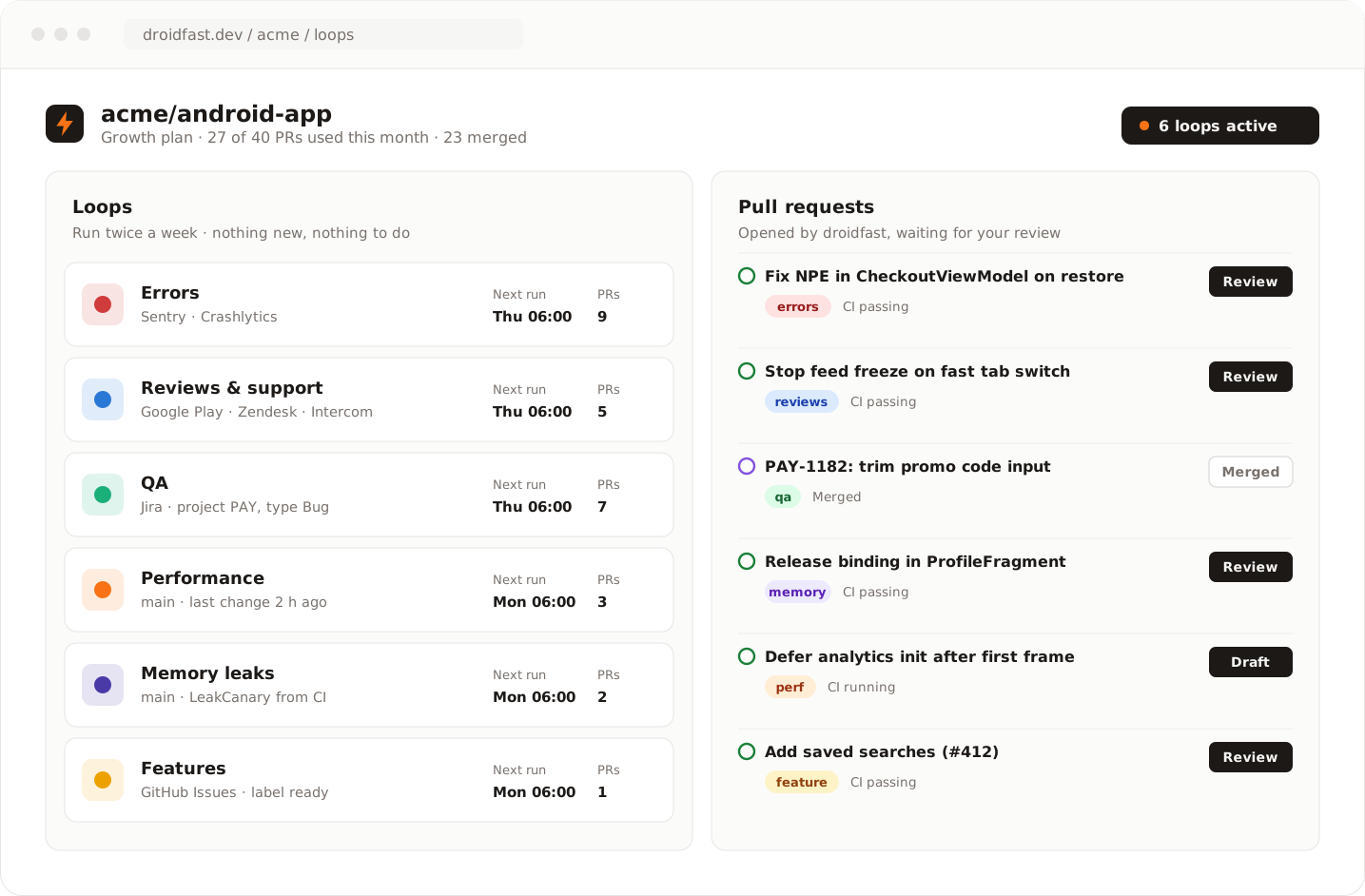
You connect your repo and the tools you already use, and twice a week droidfast:
- Reads what's new in your error monitoring, store reviews, support inbox and issue tracker
- Merges duplicates across tools, so one problem becomes one piece of work
- Sorts bugs from improvements and features, using your own labels first
- Writes the fix with Claude Opus 5.5 in the style of your codebase
- Checks it on your CI and fixes failing checks before anyone looks at it
- Opens the PR with your template, labels, reviewers and milestone
It also looks after the things nobody files a ticket for. The performance and memory-leak loops analyse your main branch twice a week and open PRs for slow startup, janky Compose screens, main-thread I/O and screens that leak, each with an explanation of what was wrong.
What it plugs into:
- Errors: Firebase Crashlytics, Sentry, Datadog, Bugsnag
- Users: Google Play reviews, Zendesk, Intercom
- Work: Jira, Linear and GitHub Issues, with your own rules for which tickets are bugs and which are features
- Code: GitHub, with your existing CI checking every pull request
You choose which loops run, which tools feed them, and what their pull requests look like.
Your team stops triaging and starts reviewing.
Jorge